Alexandria - Greek: Ἀλεξάνδρεια
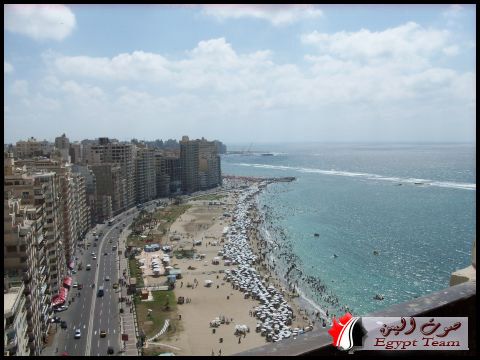
Known as the bride of the Mediterranean, is the second largest city in Egypt after the city of Cairo, is Egypt's second capital and the capital, her old, lies along the Mediterranean coast, a length of about 70 km north-west of the Nile Delta, bounded on the north Mediterranean, Lake Mariot as far south as 71 km along the Cairo Alexandria Desert Road, bordered to the east of Abu Qir Bay and the city of Edco, and the region of Sidi Krir west to 36.30 km on the road to Alexandria - the table fast.
Includes Alexandria fraught with a lot of landmarks, as there is the largest seaport in Egypt is the port of Alexandria, which serves about 80% of the total of imports and exports and also includes the new Library of Alexandria, which can accommodate more than 8 million volumes, and includes many of the museums and sites monuments such as the Bey Citadel and Pompey Pillar and others.
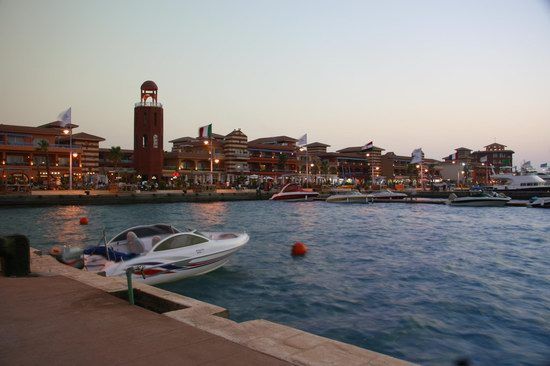
The Eastern Harbor at the Heart of Alexandria
The Port of Alexandria is considered one of the oldest ports
on the Mediterranean. By founding the city of Alexandria,
Alexander the Great aimed at founding a new port that can play
a big role in the world of trade after he had destroyed the
Port of Soor on his way to Egypt. Alexander wanted to build a
new big port to connect the ancient world countries with the
Eastern Harbor. The Eastern Harbor borders start after the
area of Al Mansheya till the Fort of Qaitbay. It is that area
that consists of Meedan Al Masajed (The Square of Mosques) and
the shore of the Eastern Harbor faces the Abi Al Abbas Al
Morsi Mosque.
At the bottom of the sea where the island of Pharos was
located, geophysical scientists found ruins of docks and
marine buildings which they argued about their origin:
1- Some think that these ruins were once part of the Port
of Alexandria during the Greek era.
2- Others think that these ruins belong to an older age
than the Greek one and date them back to Ramses II who built a
port on that location to protect Egypt against attacks from
the sea.
3- Still a third group of researchers think that these
ruins belonged to a port that was built by residents of the
island of Crete during the second century BC as their control
of the sea extended till the Egyptian shores.
Founding the Eastern Harbor
When Alexander reached Egypt, he passed on his way to Siwa a
small fishing village called Rhakotis facing a small island
called Pharos. He chose that location to found his new city
Alexandria. He connected the Pharos peninsula to the mainland
by a pier called Heptastadion which literally means “the
seven-stades long” in Greek, as the pier was about 1300 meters
long. The pier thus created two remarkable harbors, one to the
east which was the big central harbor at the time, Portus
Magnus (Currently the Eastern Harbor) and the other was
towards the west which is Eunostos or the Western Harbor, the
one which is in use now. There were two narrow paths towards
the edges of the pier to connect the two harbors. A special
port was built for the Ptolemaic kings which was called The
Port of the Kings and was located on the southern shore of
Portus Magnus.
Alexandria’s port enjoyed a great commercial significance
under the direction of the Ptolemies and during the Roman era
till the beginning of the Arab entrance to Egypt. During the
Fatimid era, the Port of Alexandria was the main commercial
port in Egypt and during the Ayoubi era, Alexandria
practically became the capital of Egypt due to the importance
of its port. During the Othmani era, the Eastern Harbor was
the one used for foreign boats to dock although it was not
suitable, as the Western Harbor, for this purpose. On the
Eastren Harbor were located the customs building and the
houses of the consulars of foreign countries and at its end is
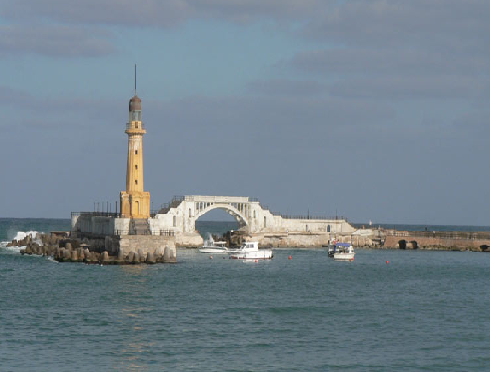
the Qaitbay Fort standing like a loyal alert guard. Even
though the Western Harbor was suitable for ship docking and
navigation, it was neglected and it lacked activity; the Port
of Alexandria deteriorated after the French Campaign on Egypt.
During Mohamed Ali’s ruling, the city of Alexandria prospered
again and its port prospered and became active again. Egypt
allowed European ships to dock in the Western Harbor which is
considered more suitable for that work than the Eastern
Harbor. This gave way to more commercial exchange between
Alexandria and European countries; afterwards, the Western
Harbor became the official port of Alexandria in 1966 and the
Alexandria Port Authority was established. The Eastern Harbor
now is only used for small fishing boats, water races and
yacht sports. It overlooks the Sayd (Fishing) Club and the
Yacht Club from the fort’s side and the two clubs make use of
the harbor’s water in various water sports. Fishermen also use
the Eastern Harbor shore in building and repairing their boats
and small ships. The Eastern Harbor shore is a tourist
attraction visited by Alexandrians where they stroll by its
side before heading to the Fort of Qaitbay for sightseeing
Ancient Monumental Tombs Of Alexandria
In our own time and only in recent years, one of the greatest cities the world has ever known is seeing, for the first time since its
decline and ultimately during the Middle Ages, its near demise, an unprecedented resurrection. Alexandria was a center of the ancient
world known for its trade and intellectualism, but like the dualism of Egypt itself, this grand metropolis became at one point one of the
worlds least cities, before making an unsteady climb back to its present status.
Prior to the Roman conquest of Egypt, Alexandria has been shown to have been overwhelmingly Greek in nature. The greatest number of
architectural elements recovered in Alexandria follow Greek models, and even the tombs initially present themselves as Hellenic, only
slowly integrating overtly Egyptian motifs. In fact, Alexandria was a Macedonian foundation established on the shores of Egypt. It was in
Egypt but it was not of Egypt and during antiquity it was called Alexandria ad Aegyptum, meaning Alexandria by or near Egypt. Even
during Roman times, the prefect's title, "Prefect of Alexandria and Egypt", continues to show this separation.
Back in its heyday, Alexandria was visited by the most prominent of world leaders, intellectuals and ancient travelers, but in the modern
era, it has, up until very recently, been almost completely avoided by foreign tourists. This was mostly because almost nothing is left
of the fabled monuments so well known to us from its magnificent past. Hence, late eighteenth and nineteenth century travelers who
were obliged to travel by sea to Egypt sojourned there as briefly as possible before traveling south to see the fabled Egypt of the
pharaohs. James Bruce, who came to Alexandria on June 20th, 1768 on his way to seek the source of the Nile, tells us that:
"Indeed, from afar Alexandria promised a spectacle deserving of attention. The view of the ancient monuments, among which one
distinguishes the column of Pompey, with the high towers and the bells constructed by the Moors, give hope of a great number of
beautiful buildings or superb ruins.But at the moment that one enters the port, the illusion vanishes and
one perceives no more than a very small number of these monuments of colossal grandeur and majesty which are distinguished and which are
found embroiled with buildings as poorly designed as they are constructed that have been raised by the conquerors who possessed
Alexandria in the last centuries.
...and now we can say of it, as of Carthage, periere ruinae. Even its
ruins have disappeared."
More recently, as air travel came into its own, Alexandria could be, and was ignored altogether as most tourists to Egypt now arrive in
Cairo. For many of the same reasons, even archaeologists, save for a few specialists, avoided Alexandria for the richer fields associated
with the earlier pharaonic era. During the early years of Egyptology, even the Egyptian government ignored the city's archaeological
potential. As Dr Tassos D. Neroutos, a resident of the city and a father of modern archaeological scholarship on Alexandria wrote in
1875:
"Whereas Egyptian archaeology enjoys the eminent protection of His Highness the Khedive in all that regards pharaonic monuments, and
while the Museum at Boulaq is enriched every day by veritable treasures drawn from excavations undertaken under the auspices of the
Government, the city of Alexandria and of the Ptolemies, on the contrary, is not the object of the same solicitude; and no thought is
given at all to the few monuments that remain still standing, nor to the undertaking of excavations in order to discover other remains of
antiquity that perhaps still lie interred beneath the earth, nor that the modern city, with its new construction, is going to bury them
forever."
In reality, this may have been a blessing. The early explorers of Egypt were little more than treasure hunters who applied none of the
science of modern archaeology to their explorations. While they devastated many ancient ruins in Egypt, they mostly avoided
Alexandria, leaving many of its ruins for their more articulate, modern followers.
This is not to say that there has not been, for many years, excavations and scholarly work undertaken in Alexandria, but we can
pinpoint almost precisely Alexandria's renewed interest to the underwater excavations during the 1990s (which continue today).
Beneath the sea on Alexandria's coast lies an impressive array of antiquities, some perhaps tossed there to block the waters from
attack, but probably most toppled into the sea by massive earthquakes that plagued the area for many hundreds of years. Here are the
remains of famous palaces and many other structures, including the Pharos Lighthouse. Whether these ruins spurred the revival of the
Ancient Library of Alexandria by the Egyptian Government is unknown to us, but its recreation in Alexandria has likewise helped spawn a
renewed interest in the city, creating a certain momentum in its rediscovery.
On land, by far the most numerous archaeological sites are below ground, and mostly consist of tombs. Many of these have, more or less
quietly, been excavated over many years and in fact numerous of them were done so prior to World War II. The greatest advance in the
knowledge of the material remains of ancient Alexandria actually took place under the direction of Achille Adriani between 1932 and 1940
and again between 1948 and 1952. Yet, until the finds of the harbor and the building of the library, there was little interest outside of
specific circles in this work, and while there has been considerable public and scholarly interest in the underwater excavations, the
tombs are just now earning some expanded interest.
Perhaps one reason for this lack of interest in the tombs is that there are no royal tombs left, save for one known as the Alabaster
Tomb. Even that is uncertain, but it has all of the attributes of a royal tomb, and it has even been suggested and argued that it was in
fact a tomb where Alexander himself was interred. If so, it would have been his second resting place. Uncovered in 1907, it is
constructed in an area that might very well have been in the Sema, the cemetery associated with Alexandria's royalty. It is notable for
its formal divergence from other Alexandrian tombs. Unlike other tombs in Alexandria, it seems to follow a Macedonian architectural
model as well, and is constructed of monolithic slabs of alabaster. However, not much remains of this tomb and its actual ownership may
never be known.
Later private tombs in Alexandria draw more upon elements from Greece and Egypt, with the Egyptian style growing over time. The earliest
known tombs were modest, with multiple burials cut into soft limestone to the east of the city. They soon evolved into multi-
chambered complexes conceived as collective burial places centered on spaces for enactment of the funeral cult drama (ritual ceremony), as
tombs spread to the west of the city along the Mediterranean coast. Architecturally, the monumental private tombs of Alexandria have no
identifiable forerunners in the Hellenic world, despite the fact that the city was so very Greek. Like Egyptian tombs, those at Alexandria
are rock cut, but they are also unlike Egyptian tombs outside of Alexandria. In 1919, Rudolf Pagenstecher categorized two types of
Alexandrian monumental tombs as Oirkos, with rooms distributed on a linear axis, and peristyle, having rooms distributed around a
peristyle or psuedo-peristyle court. However, in her book, Monumental Tombs of Ancient Alexandria, Marjorie Susan Venit tells us that:
"... although the terms are useful as descriptors and although this division has remained the basis of the discussion of Alexandrian tomb
architecture, the differentation does not seem conceptually, ethnically, or chronologically significant - and in a recent article,
Wiktor Daszewski has argued that it is not descriptively valid either. Yet Pagenstecher's divisions pervade scholarly literature,
and his terms, at least, are still worth applying when they are appropriate."
Irregardless, Alexandrian monumental tombs do share common elements no matter what date. Ptolemaic Period tombs are similar at the
beginning and at the end of the period, and even Roman period tombs are grounded in their Ptolemaic prototypes, though there are a number
of important differences between those of the two politically distinct period. These private tombs all differ from the Macedonian
model. They are cut vertically into the rock and are accessed by a covered rock-cut staircase. They are centered on a court open to the
sky, which was probably surrounded by a parapet, though none are preserved in Alexandria itself. About this court was a series of
rooms with their main focus on a burial chamber furnished with a rock-cut kline on which the body of the deceased must have been laid
out. In addition, there were other burial rooms containing loculi (long, narrow shelves or niches) cut into the walls when needed to
serve as burial slots and closed with loculus slabs. Though Alexandria had a diverse population from many nationalities, even
cultural distinctions seem to have collapsed in these tombs.
In the Roman Period tombs, the arrangement was similar, though they did away with the kline chamber and broadened the range of elements
to incorporate the specific needs of the Roman Funerary ritual. For the disposition of the great majority of the dead, Roman Period tombs
retian loculi, although these were normally precut in contrast to their ad hoc opening in the Ptolemaic period. For the those of means,
a freestanding limestone sarcophagi or rock-cut sarcophagi set into trabeated or arctuated niches (arcosolia) were used. These tombs
could also incorporate a funerary building on the surface and triclinium dining rooms for memorial feasts.
Despite some differences in Roman tombs, three elements consisting of the loculi, klinai and sarcophagus niches are characteristic of
Alexandrian tombs. While the Klinai was utilized almost exclusively in Ptolemaic tombs and sarcophagus niches are strictly of the Roman
period, loculi, the long, narrow, often gabled or vaulted depositories for the dead continue throughout the history of
Alexandrian tombs.A number of scholars have suggested that the loculi were borrowed
from other cultures such as the Phoenicians, but in fact pre-Ptolemaic Egypt has plenty of examples from which these may have more
likely been modeled. They are a feature of Late Period necropolises of deified animals at Saqqara and the necropolis of Memphis.
In Alexandria, these loculi niches were not necessarily limited to a single burial, nor were they subject to a specific type of
internment. Loculi even held cremations, and as many as a dozen interred bodies.
While the loculi were rarely painted on the inside, they were sealed over by a slab which was decorated by paint usually in the Ptolemaic
Period and inscribed during the Roman Period. By far, the large majority of these were, during the Greek Period, painted to portray a
Doric portal, or door. However, it should be noted that these doors probably had nothing in common with the symbolism of false doors of
the earlier pharaonic periods which were incorporated into tombs. The Klinai, which were couches, were present in most all early and
middle Hellenistic Alexandrian tombs. These were used during life for resting upon, and likewise to ret the dead during death. While Loculi
could very well be modeled on earlier Egyptian examples, the Kline probably originated in Anatolia, where funerary beds especially
fabricated to furnish tombs are known as early as the sixth century BC.
By far the most common type found in Alexandrian tombs is a single kline carved from the long back wall of small chamber filling the
room. Two types of funerary klinai are known from Egypt. One functioned as a sarcophagus, while the more common type did not. Of
these, the sarcophagus style kline was probably the earliest form. Both actually look similar and were cut from the rock, projecting out
from the wall as would a real couch. Of course, there are some exceptions to these rules, as well as later
reuses of many tombs which altered some of their elements.
Resources:
Title
Author
Date
Publisher
Reference Number
Alexandria, City of the Western Mind
Vrettos, Theodore
2001
Free Press, The
ISBN 0-7432-0569-3
Alexander to Actium (The Historical Evolution of the Hellenistic Age)
Green, Peter
1990
University of California Press
ISBN 0-520-05611-6
Alexandria Rediscovered
Empereur, Jean-Yves
1998
British Museum Press
ISBN 0-7141-1921-0
Atlas of Ancient Egypt
Baines, John; Malek, Jaromir
1980
Les Livres De France
None Stated
Monumental Tombs of Ancient Alexandria: The Theater of the Dead
Venit, Marjorie Susan
2002
Cambridge University Press
ISBN 0 521 80659 3
Oxford Encyclopedia of Ancient Egypt, The
Redford, Donald B. (Editor)
2001
American University in Cairo Press, The
ISBN 977 424 581 4
Al Shatby Monumental Tomb
Address: El Shatby, infront of Saint Marc College, between Port Said Street and the Corniche Avenue.
Visiting hours: 9 am till 5 pm
The earliest tombs, including those classified as monumental at Alexandria, are found in the eastern cemetery, and particularly at Shatby. The cemetery at Shatby probably dates to the period almost immediately following the foundation of the city of Alexandria. Al Shatbi Monumental Tomb was discovered accidentally in 1893, and it dates back to the late second century and early third century BC. It is considered to be the oldest Ptolemic tomb discovered in Alexandria because it begins immediately east of the conjectured line of the city walls near the sea at Shatby.
This is a multi-chambered tomb accessed by a stairway that was cut down through the rock. It mimics a monumental building with a court open to the sky around which the burial chambers and subsidiary rooms are arranged. The burial rooms within the tomb incorporate architecturally elaborate loculi and two klinai for burial, while its court accommodated an altar for sacrifice. The only feature that is lacking is a well or cistern, which was incorporated into later Ptolemaic period tombs.
The tomb is cut into the rock and contains many monuments from the Ptolemic age, most important of which are the Tenagra statues.
The main tomb has an entrance that leads to a horizontal hall then to another hall then to an open court and the eastern side of that court leads to a front room that in turn leads to the burial room.
The tomb originally centered on a court open to the sky. About this court was a series of rooms with their main focus on a burial chamber furnished with two rock-cut klines on which the body of the deceased must have been laid out.
The tomb was patterned after an old Greek house with an entrance, a front room, and a back room, and this part of the tomb dates back to the first half of the third century BC. This tomb was originally a private crypt, but was later extended with more public burials.
Many new parts were added to the tomb that were not there before, these parts date back to later ages than the original age of the tomb. Pots were found in one of the rooms that date back to the third century BC.
Two burial methods were used in this tomb:
The First Method:
Laying out the body on a funerary bed (as in the main tomb where there are two klines)
The Second Method:
There are other burial rooms containing loculi (long, narrow shelves or niches) cut into the walls when needed to serve as burial slots and closed with loculus slabs (The first method is older than the second one).
The main tomb had elaborate architectural decorations which were patterned after Greek style. The architecture of the tomb along with the pots and burial utensils that were found in it all indicate that it was constructed around 260 BC to serve as a private crypt then it was expanded into a public cemetary in the late third century BC
Submerged Antiquities in Alexandria
Alexandria coasts are full of submerged antiquities especially in the areas of Abu Qir bay and the Eastern Harbor. As a result of the exposure of the ancient city of Alexandria to several earthquakes, many of the palaces, buildings and forts of Alexandria were submerged under the sea water. The Alexandria lighthouse, for example, one of the ancient seven wonders, is regarded as one of the most famous antiquities submerged under sea water. In addition to earthquakes, sea water level has increased by two meters since the Roman age.
Search for these submerged antiquities in Egypt started in 1933 and some were snatched from the Abu Qir bay. Later in 1961, the well-known diver and archeologist Kamel Abu Al Sa'dat discovered submerged antiquities in the Eastern Harbor area in front of the Fort of Qaitbay. Kamel Abu Al Sa’dat snatched some potteries and delivered them to the Greaco-Roman Museum in 1961, and then he snatched a gold coin that dates back to the Hellenistic age and delivered it to the museum as well.
In 1962, Al Sa’dat declared that there are huge statues and other antiquities that he had seen himself under the water. The Egyptian Antiquities Authorities officially collaborated with the Navy for the first time in order to snatch Granite statue of a man with a cloak that covers most of his body of height 170 cm. That statue was snatched in the first half of November in 1962. During the second half of November in 1962, the huge statue known as the Isis Statue was snatched. It was made of red Granite and of height 7.5 meters cut into half and was moved to the garden of the Marine Museum in Alexandria.
In 1968, the Egyptian government called for the UNESCO for assistance in drawing a map of the submerged antiquities in the Eastern Harbor area, so it sent an international submarine which succeeded in making the required map in 1975 which has since become a reference for work in that area.
In 1992, an archeological mission headed by Frank Guido sent by the Europe Seas Research Institute looked for submerged antiquities in Abu Qir and the Eastern Harbor. Thanks to his experience, his advanced equipments and his data analysis, he managed to reveal many of the mysterious secrets of the Alexandria submerged antiquities. In October, 1992, the mission of the National French Research Institute in Alexandria started the scanning process of the sea bottom. The French Institute mission consisted of 30 French and Egyptian divers. They discovered thousands of antiquities below the Qaitbay Fort such as pillars and statues and archeological elements from the ancient Egyptian, Greek and Roman ages. One of the pillars looked similar to the Sawari Pillar which gave a reminder to the incident of throwing pillars and rocks into the sea bottom in 1167 as protection strategy against the crusaders attacks.
A number of sphinxes were also found with various engravings and with different sizes and made of different stones. All these submerged antiquities date back to the period from the Modern State age to the Hellenistic Age; a pillar was found with its crown with the shape of a papyrus flower and another pillar with the cross sign. In 1996, the Administration for Submerged Antiquities was established in Alexandria and it is affiliated with the Supreme Council for Antiquities and it consists of a group of Egyptian archeologists headed by Archeologist/ Ibrahim Darwish, a pioneer diver in Egypt.
The Egyptian-Greco excavation has recently worked in the area located between Al Shatbi and Sidi Gaber and discovered reservoirs engraved in the rocks in a deep area of the sea and the most important reservoirs were found in the area of Ibrahimeya.
A study is currently being carried out on the possibility of setting up the first museum for submerged antiquities in the city of Alexandria and the eastern Harbor area has been chosen as the location for the museum which will be the first museum for submerged antiquities in the world. It will be established as collaboration between the UNESCO and the Egyptian Ministry of Culture (the Supreme Council of Antiquities).
Dr. Zahi Hawas, Secretary General of the Supreme Council of Antiquities, has stressed that the submerged antiquities museum is going to display cultural and rare heritage and show the greatness of the Egyptian civilization throughout all ages. In collaboration with the UNESCO, the Egyptian government invited Egyptian and International experts to discussion and dialogue on all the fields concerned with constructing the museum. Francoise Riviere, UNESCO’s Assistant Director-General, has stressed the depth and continuity of collaboration between the organization and Egypt in conserving its heritage through many projects that had been carried out, most prominent of which is the campaign of saving the Nubia monuments and the Philae Museum. She said that, during her visit to Egypt, she had already discussed with the Minister of Culture the possibility of conserving the submerged heritage, especially after the UNESCO had issued an agreement in 2001 of protecting underwater cultural heritage which draws the general framework of conserving it
.
The Fine Arts Museum in Alexandria
Address: Infront of 6 Mansha Street, Moharam Bek, Alexandria
Telephone: 03-3936616
Website: www.fineart.gov.eg
Visit Hours: 10 am till 6 pm (except Mondays)
Ticket Fares: Entry is free
The Fine Arts Museum in Alexandria is considered one of the cultural and artistic landmarks in the city of Alexandria. This museum was built in 1954 and was constructed on a land that Baron De Mansha gave as a gift to the governorate of Alexandria. He was one of the wealthy foreign merchants who lived in Alexandria.
At that time, Hussein Sobhy was the governor of Alexandria and he was known as a sponsor of the artistic movement in Alexandria. After his death, the museum was named after him; it was known as The Hussein Sobhy Museum for several years till it was named The Fine Arts Museum.
Baron De Mansha presented the governorate of Alexandria with a piece of land to be used in building the museum so as to display the valuable works of Artist Edward Fredheim that were about 210 works of art. In 1949, architect Fouad Abdel Hamid was assigned the design of the first museum for fine arts in Egypt and the Arab World and even in all Africa, it was the firts museum to be built specifically for that purpose.
When the construction of the museum was finished in 1954, leaders of the Revolution, on top of whom was Gamal Abdel Nasser inaugurated the museum during the July Revolution celebrations. After a year of the inauguration in 1955, the Alexandria Biennale was organized there for the first time. The first round of the Biennale was inaugurated by Gamal Abdel Nasser along wih other leaders of the Revolution and a number of prominent seminal artists in Egypt such as Mahmoud Said, Mohamed Nagi, Henna Samika, Saad Al Khadem, Hussein Bikar, Mohamed Hassan, Kamal Al Malakh, Habib Georgy and Hussein Sobhy. Since then, the museum organizes the Alexandria Biennale every two years to display the art of the Meditteranean countries. In 1995, the Sector of Fine Arts affiliated with the Ministry of Culture took over the administration of the museum.
The museum includes many display halls, a library for arts and a cultural center where concerts are performed and cultural seminars are held. The museum also houses 1381 pieces of sculptures, paintings and architectural works for famous artists. Moreover, exhibitions by contemporary artists, both Egyptian and non-Egyptian are often held there. Right next to the museum lies the Library of Fine Arts which dates back to 1892 and used to be affiliated with the Graeco-Roman Museum. In 1940, that villa was destroyed after it was bombarded during World War II. In 1948, it was reconstructed and was redesigned to be a library. In 1998, the library was no longer affiliated with the governorate of Alexandria but rather to the Sector of Fine Arts in the Ministry of Culture. The Library includes about 200,000 volumes and books in different fields and in different languages. Among this valuable collection is the book of “Description of Egypt” that was put down in 11 volumes by the scientists and scholars of the French campaign. In 2005, the 23rd round of the Alexandria Biennale was held in the Museum of Fine Arts under the title, “The Transparency of the Universe...The Charm of the Meditteranean.” A big celebration was held to mark the passing of 50 years since the first Biennale was held in the Museum of Fine Arts (the Golden Jubilee of the Alexandria Biennale
The Fine Arts Museum in Alexandria
Address: Infront of 6 Mansha Street, Moharam Bek, Alexandria
Telephone: 03-3936616
Website: www.fineart.gov.eg
Visit Hours: 10 am till 6 pm (except Mondays)
Ticket Fares: Entry is free
The Fine Arts Museum in Alexandria is considered one of the cultural and artistic landmarks in the city of Alexandria. This museum was built in 1954 and was constructed on a land that Baron De Mansha gave as a gift to the governorate of Alexandria. He was one of the wealthy foreign merchants who lived in Alexandria.
At that time, Hussein Sobhy was the governor of Alexandria and he was known as a sponsor of the artistic movement in Alexandria. After his death, the museum was named after him; it was known as The Hussein Sobhy Museum for several years till it was named The Fine Arts Museum.
Baron De Mansha presented the governorate of Alexandria with a piece of land to be used in building the museum so as to display the valuable works of Artist Edward Fredheim that were about 210 works of art. In 1949, architect Fouad Abdel Hamid was assigned the design of the first museum for fine arts in Egypt and the Arab World and even in all Africa, it was the firts museum to be built specifically for that purpose.
When the construction of the museum was finished in 1954, leaders of the Revolution, on top of whom was Gamal Abdel Nasser inaugurated the museum during the July Revolution celebrations. After a year of the inauguration in 1955, the Alexandria Biennale was organized there for the first time. The first round of the Biennale was inaugurated by Gamal Abdel Nasser along wih other leaders of the Revolution and a number of prominent seminal artists in Egypt such as Mahmoud Said, Mohamed Nagi, Henna Samika, Saad Al Khadem, Hussein Bikar, Mohamed Hassan, Kamal Al Malakh, Habib Georgy and Hussein Sobhy. Since then, the museum organizes the Alexandria Biennale every two years to display the art of the Meditteranean countries. In 1995, the Sector of Fine Arts affiliated with the Ministry of Culture took over the administration of the museum.
The museum includes many display halls, a library for arts and a cultural center where concerts are performed and cultural seminars are held. The museum also houses 1381 pieces of sculptures, paintings and architectural works for famous artists. Moreover, exhibitions by contemporary artists, both Egyptian and non-Egyptian are often held there. Right next to the museum lies the Library of Fine Arts which dates back to 1892 and used to be affiliated with the Graeco-Roman Museum. In 1940, that villa was destroyed after it was bombarded during World War II. In 1948, it was reconstructed and was redesigned to be a library. In 1998, the library was no longer affiliated with the governorate of Alexandria but rather to the Sector of Fine Arts in the Ministry of Culture. The Library includes about 200,000 volumes and books in different fields and in different languages. Among this valuable collection is the book of “Description of Egypt” that was put down in 11 volumes by the scientists and scholars of the French campaign. In 2005, the 23rd round of the Alexandria Biennale was held in the Museum of Fine Arts under the title, “The Transparency of the Universe...The Charm of the Meditteranean.” A big celebration was held to mark the passing of 50 years since the first Biennale was held in the Museum of Fine Arts (the Golden Jubilee of the Alexandria Biennale